50/30/20 rule
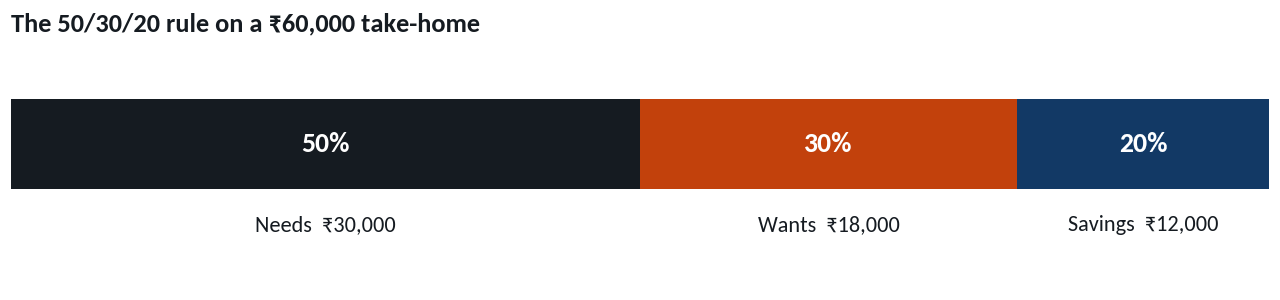
A budgeting split of take-home pay: half to needs, three-tenths to wants, one-fifth to savings.
FormulaNeeds 50% · Wants 30% · Savings 20%
ExampleOn ₹60,000: ₹30,000 needs, ₹18,000 wants, ₹12,000 savings.
Reference
129 money terms in plain language. Each one has what it means, the formula where there is one, and a worked example. Examples use Indian figures and conventions.
A budgeting split of take-home pay: half to needs, three-tenths to wants, one-fifth to savings.
FormulaNeeds 50% · Wants 30% · Savings 20%
ExampleOn ₹60,000: ₹30,000 needs, ₹18,000 wants, ₹12,000 savings.
The income tax section permitting deductions for specified investments and payments up to an annual cap, under the old regime.
ExampleEPF, PPF, ELSS, life insurance premiums and home loan principal all compete for the same limit.
A one-time charge at entry to an institution, separate from recurring tuition. Frequently omitted from budgets because it occurs once.
Example₹35,000 admission fee in the year a child changes school, on top of the usual annual fees.
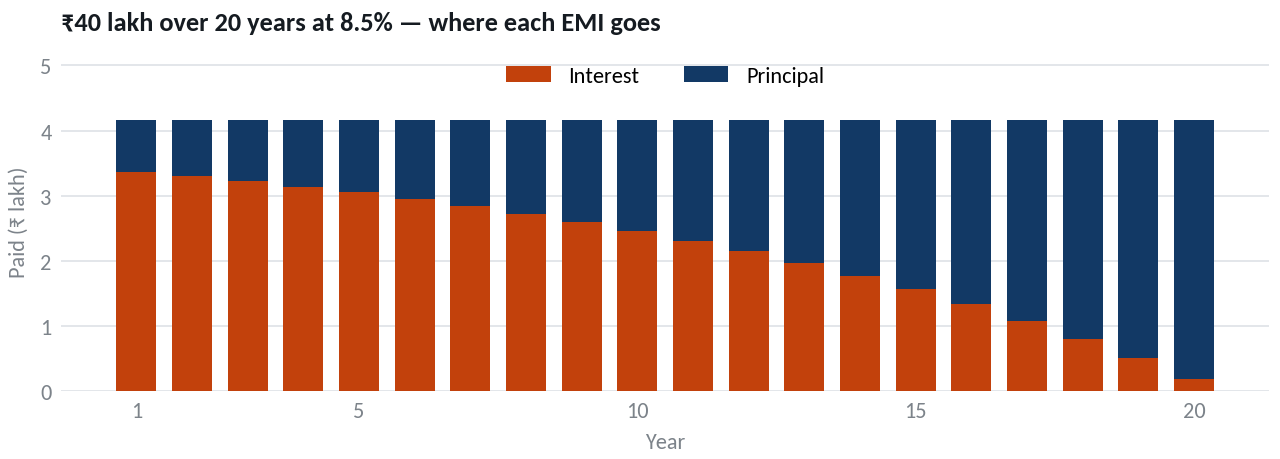
The gradual repayment of a loan through instalments covering both interest and principal. Early instalments are mostly interest; the balance shifts over time.
ExampleIn year one of a 20-year home loan, roughly 80% of each EMI is interest.
Any monthly figure multiplied by twelve, shown alongside monthly values so the yearly weight of a small recurring cost is visible.
FormulaAnnual = Monthly × 12
Example₹450/month on streaming subscriptions is ₹5,400 a year — roughly a month of groceries.
A once-a-year cost divided by twelve and set aside monthly, so the month it falls due does not break the budget. Used for school fees, insurance premiums, property tax and vehicle insurance.
FormulaMonthly provision = Annual cost ÷ 12
ExampleSchool fees of ₹48,000 a year become a ₹4,000 monthly provision.
A series of equal payments at regular intervals — an SIP paying in, or a pension paying out.
FormulaFV = P × [((1+i)ⁿ − 1) ÷ i]
Example₹5,000/month for 10 years at 12% accumulates to about ₹11.6 lakh.
How a portfolio is divided across equity, debt, gold and property. The division matters more to long-run outcomes than the selection within each class.
ExampleA common starting rule: equity share ≈ 100 − age. At 35, roughly 65% equity.
Moving an outstanding loan or card balance to another lender at a lower rate. Worth checking before optimising a repayment order.
ExampleShifting ₹85,000 of card debt from 40% to an 18% personal loan saves roughly ₹1,550 a month in interest.
A place a bank keeps your money safely, from which you can take it out or pay others.
ExampleMoney in a savings account earns a small amount of interest while it sits there.
The RBI-conceived, NPCI-operated network that routes bill payments between billers and payment apps. Nearly every Indian bill payment app runs on it.
ExamplePaying an electricity bill through any major app routes through the same underlying network.
Using someone else's money now and returning more than you took, later. The extra is the cost of using it early.
ExampleBorrow ₹1,000 for a year at 10% and you return ₹1,100.
A plan for money that decides where it goes before it is spent, rather than explaining where it went afterwards.
ExampleOf ₹500 pocket money: ₹200 to spend, ₹200 to save, ₹100 to share.
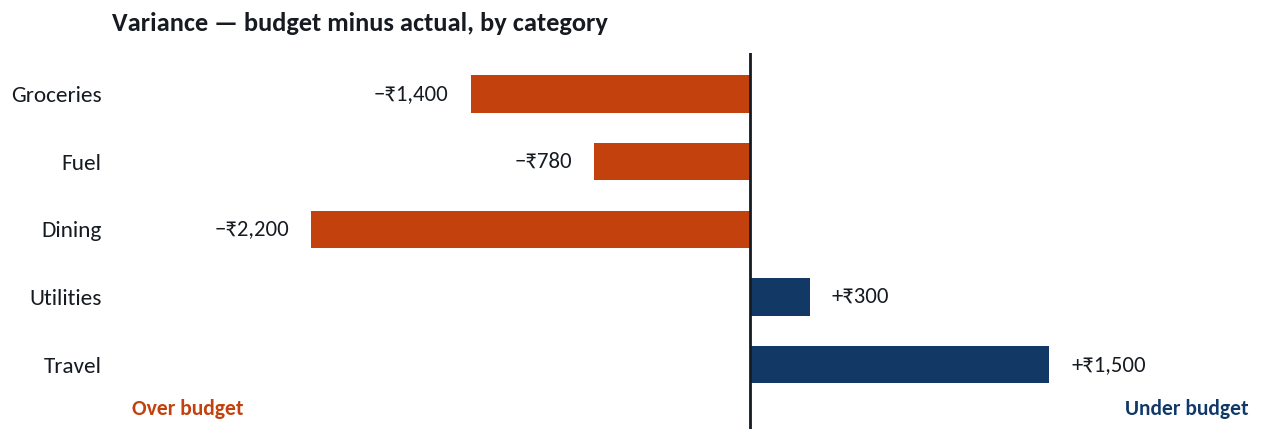
The comparison between what you planned to spend in a category and what you actually spent, once the month's records are in.
FormulaVariance = Budget − Actual
ExampleGroceries budgeted ₹9,000, actual ₹10,400 → variance −₹1,400, i.e. over budget.
Profit on selling an asset for more than it cost. Classified short or long term depending on the holding period, which determines the tax treatment.
FormulaGain = Sale price − Purchase price − allowable costs
ExampleEquity units bought at ₹1,00,000 and sold at ₹1,45,000 produce a ₹45,000 gain.
An unofficial payment demanded for admission beyond published fees. Prohibited in most Indian states and unrecoverable in disputes.
ExampleAny payment without a receipt is, by definition, unrecoverable.
A spending record added manually because the money never passed through a bank account — domestic help, vendors, cheque payments, cash medical bills.
Example₹9,000 to domestic help and ₹1,800 to the milk vendor: invisible to any payment app, two taps here.
The sum of all line items within one expense group, used to compare groups rather than individual entries.
FormulaSubtotal = Σ line items in the category
ExampleUtilities subtotal = electricity ₹1,500 + water ₹250 + gas ₹900 + internet ₹700 = ₹3,350.
A rotating savings and credit arrangement where members contribute monthly and take turns receiving the pool, usually by bidding. Registered chits are regulated; unregistered ones carry substantial counterparty risk.
ExampleTwenty members at ₹5,000 a month create a ₹1,00,000 monthly pool auctioned to one member.
A parent or guardian who shares legal responsibility for repaying an education loan. Their credit history affects approval and pricing.
ExampleA parent as co-applicant with a strong credit score can reduce the rate offered.
An education loan sanctioned without pledged security, generally up to a threshold amount and subject to the institution's standing.
ExampleLoans up to about ₹7.5 lakh are commonly available without collateral; verify with the lender.
Growth that builds on earlier growth, so the increase gets larger each period.
FormulaA = P × (1 + r)ⁿ
Example₹100 growing 10% a year is ₹110 after one year, and ₹121 after two — not ₹120.
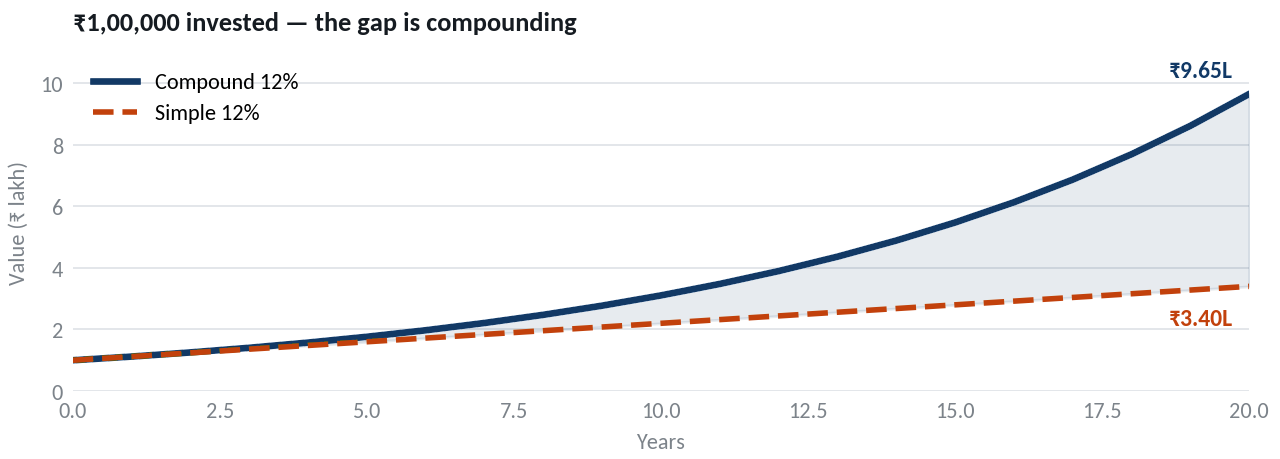
Interest earned on interest already earned. The mechanism behind every long-horizon investment outcome.
FormulaA = P × (1 + r)ⁿ
Example₹1,00,000 at 12% becomes ₹3,10,585 in ten years — the extra ₹90,585 over simple interest is compounding.
An accumulated sum set aside for a defined purpose — retirement, a child's education, a house.
ExampleA retirement corpus of ₹2 crore supporting ₹8 lakh of annual withdrawals.
What must be given up to obtain something — usually money, sometimes time.
ExampleA ₹40 snack every school day costs about ₹800 a month.
Permission to take something now and pay for it later. Convenient, and dangerous if the later payment is not planned for.
ExampleA credit card is a short loan that becomes expensive if it is not repaid in full.
A three-digit summary of repayment behaviour, typically 300–900 in India. Lenders use it to price and approve credit.
ExampleAbove 750 is generally treated as strong; below 650 restricts options and raises rates.
The share of available card limit in use. A significant input to credit scores; keeping it low helps even when bills are paid in full.
FormulaUtilisation % = (Balance ÷ Credit limit) × 100
Example₹90,000 used against a ₹3,00,000 limit = 30%, generally considered the upper comfort bound.
The employer's total cost of employing you, including contributions and benefits you never receive as cash. Consistently mistaken for salary.
Example₹12 lakh CTC may include ₹86,400 of employer PF and ₹50,000 of benefits never seen in the bank.
Money owed to someone else. Not inherently bad — a home loan builds an asset — but it must be repaid from future income.
Example₹50,000 borrowed for a phone is repaid from money not yet earned.
Repaying the highest interest rate debt first while paying minimums elsewhere. Mathematically optimal; saves the most total interest.
ExampleA 40% card balance is attacked before a 14% personal loan, regardless of which is larger.
Repaying the smallest balance first for the psychological win, then rolling that payment into the next. Costs more in interest but is completed more often.
ExampleClearing a ₹22,000 consumer loan in three months before turning to an ₹85,000 card balance.
Monthly debt repayments as a share of income. Lenders assess it; households should too.
FormulaDTI % = (Total monthly debt payments ÷ Gross monthly income) × 100
Example₹32,000 of EMIs on ₹85,000 income = 38%. Most lenders resist above 50%.
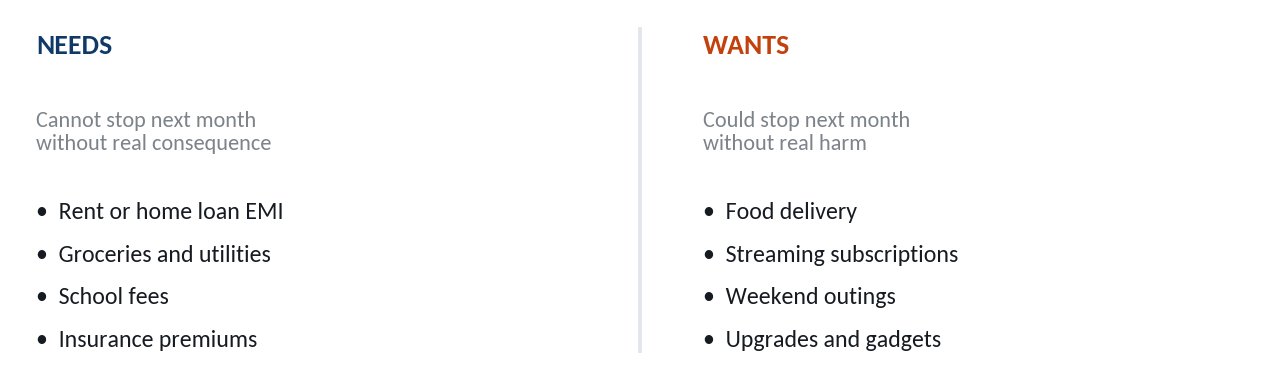
Spending you could stop next month without material consequence. The first place to look when a budget does not balance.
ExampleDining out, food delivery, streaming subscriptions, weekend outings.
Spreading money across assets that do not move together, so one poor outcome does not determine the whole.
ExampleEquity funds, PPF, gold and a liquid fund held together rather than a single instrument.
A share of profit distributed to shareholders or unit-holders. Taxable in the recipient's hands in India.
Example100 shares paying ₹18 per share yields ₹1,800, added to income and taxed at slab.
Receiving money in exchange for work, or from money already saved.
ExampleA salary is earned from work; interest is earned from savings.
The accumulated sum targeted for a child's higher education, built over years and sized against inflated future costs rather than today's.
FormulaFuture cost = Current cost × (1 + education inflation)ⁿ
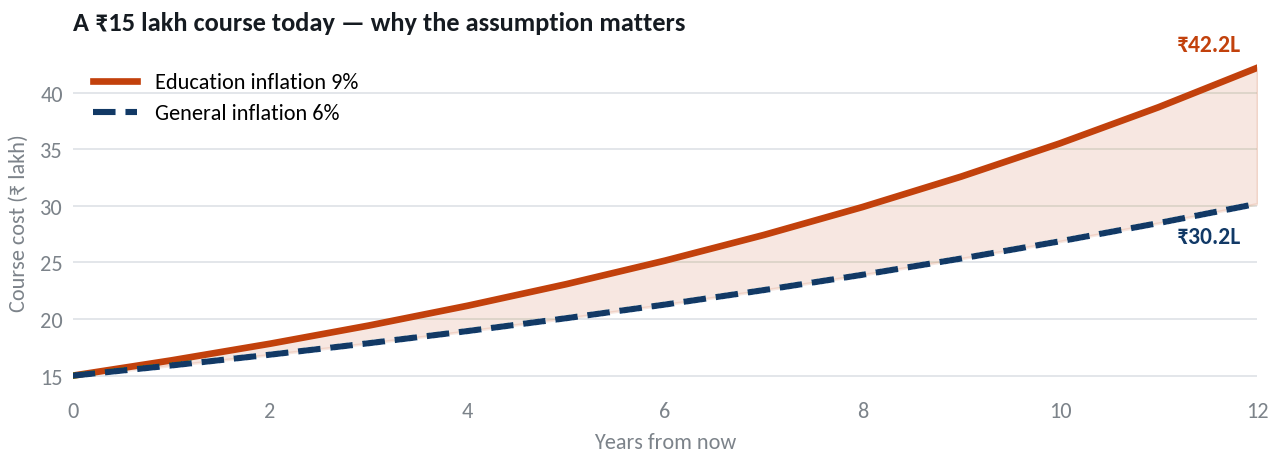
ExampleA course costing ₹15 lakh today, at 8% education inflation, costs about ₹32 lakh in twelve years.
The rate at which education costs rise, historically faster than general inflation in India — commonly assumed at 8–10% for planning.
ExampleUsing general inflation of 6% instead of 9% undersizes a twelve-year corpus by roughly a third.
Borrowing to fund tuition and associated costs, usually with a moratorium during study and repayment beginning after course completion.
Example₹20 lakh at 10% over 10 years, repayment starting after a two-year moratorium.
Liquid savings held exclusively for genuine emergencies. The difference between a shock and a debt spiral.
FormulaTarget = Monthly expenses × 3 to 6
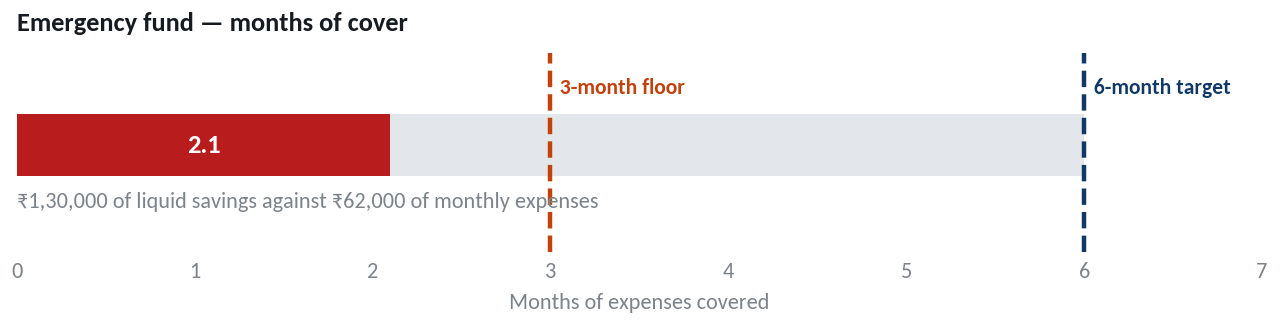
Example₹62,000 monthly expenses → ₹1.86 lakh minimum, ₹3.72 lakh preferred.
How many months of your total expenses your liquid savings would cover if income stopped.
FormulaMonths = Liquid savings ÷ Monthly expenses
Example₹1,30,000 in savings against ₹62,000 monthly expenses = 2.1 months — below the 3-month floor.
The liquid savings goal, set as a chosen number of months of expenses. Three months is the floor; six is the common recommendation.
FormulaTarget = Monthly expenses × chosen months
Example₹62,000 × 6 = ₹3,72,000.
The fixed monthly loan repayment covering interest and principal.
FormulaEMI = P × r × (1+r)ⁿ ÷ ((1+r)ⁿ − 1)
Example₹40 lakh over 20 years at 8.5% gives an EMI of about ₹34,700.
Total monthly loan and card repayments as a share of take-home income. The single most reliable measure of borrowing stress.
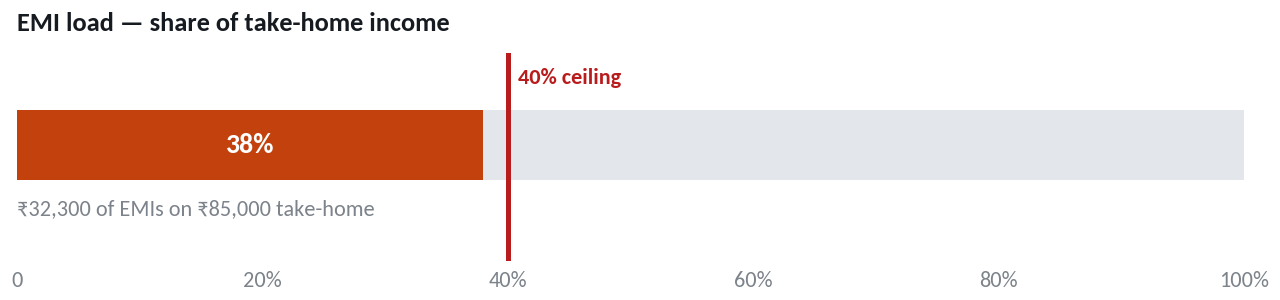
FormulaEMI load % = (Total EMIs ÷ Take-home income) × 100
ExampleEMIs of ₹32,300 on income of ₹85,000 = 38% — approaching the 40% ceiling.
A mandatory retirement scheme for salaried employees, with employee and employer both contributing 12% of basic pay. Interest is declared annually by EPFO.
FormulaContribution = 12% of basic + DA, matched by the employer
ExampleOn ₹40,000 basic, ₹4,800 from you and ₹4,800 from the employer each month.
Spending you cannot stop next month without real consequence — housing, food, utilities, school fees, insurance premiums, minimum loan payments.
ExampleRent ₹15,000 and the vehicle EMI ₹4,500 are essential; the ₹1,200 delivery habit is not.
What you plan to spend in each category before the month begins. The plan the month is later measured against.
ExampleSetting groceries at ₹9,000 in advance, rather than discovering ₹10,400 afterwards.
Money going out. Some are unavoidable, some are chosen.
ExampleElectricity is unavoidable; a second streaming subscription is chosen.
The annual rate at which you assume your costs will rise, used in projections. India has averaged roughly 5–7%.
FormulaYear n expenses = Current × (1 + inflation)ⁿ
Example₹62,000/month at 6% becomes about ₹83,000/month in five years.
The annual percentage a fund charges for management, deducted from returns before you see them. Direct plans cost less than regular ones because no distributor commission is embedded.
ExampleA 1.5% regular plan versus a 0.6% direct plan costs about ₹9,000 more per year on ₹10 lakh invested.
Mutual fund investments are subject to market risks. Read all scheme-related documents carefully.
A term in a school or college agreement permitting annual fee increases, often at a stated percentage.
ExampleA 10% annual escalation turns ₹80,000 of fees into about ₹1,28,000 in five years.
Financial Independence, Retire Early — building a corpus large enough that work becomes optional, usually through a savings rate of 50% or more.
FormulaCorpus = Annual expenses × 25
Example₹6 lakh of annual expenses implies a ₹1.5 crore target.
The portfolio size at which annual expenses can be withdrawn indefinitely at roughly 4% a year.
FormulaCorpus = Annual expenses × 25
ExampleMonthly expenses ₹50,000 → annual ₹6,00,000 → corpus ₹1.5 crore.
A deposit held for a fixed term at a fixed rate. Predictable, liquid on premature withdrawal with a penalty, and taxable at slab.
Example₹2 lakh for 3 years at 7% returns about ₹2.45 lakh before tax.
The margin charged on foreign currency transactions when paying overseas tuition or living costs.
ExampleA 3% markup on a ₹20 lakh remittance costs ₹60,000; specialist remittance services charge less.
Something specific you are saving towards, with an amount and a date attached.
Example"₹12,000 for a cycle by December" is a goal; "save more" is not.
A lump sum paid by an employer on exit after five or more years of service.
FormulaGratuity = (15 ÷ 26) × Last drawn salary × Years of service
Example₹50,000 last salary × 10 years × 15/26 ≈ ₹2,88,462.
Total pay before tax, provident fund and other deductions. In India usually quoted as CTC. Never budget on this figure.
ExampleA ₹12 lakh CTC typically delivers ₹72,000–78,000 a month in hand, not ₹1,00,000.
Cover for hospitalisation costs. In the absence of broad public coverage, the most common route from a stable household to debt is an uninsured medical event.
ExampleA family floater of ₹10 lakh for a family of four, with top-up cover above it.
Insurance is the subject matter of solicitation.
Combined income and spending across everyone in the household, rather than one earner's share.
Example₹60,000 + spouse ₹25,000 = ₹85,000 household income; the budget is built on this.
The portion of house rent allowance exempt from tax, calculated as the least of three amounts.
FormulaLeast of: actual HRA; rent − 10% of salary; 50% of salary (metro) or 40% (non-metro)
ExampleVerify against current rules; the new tax regime does not permit this exemption.
Money coming in — from work, from a business, from rent, or from investments.
ExampleA household with two earners has two income streams, and both belong in the budget.
The rate at which prices rise, reducing what money buys. The silent constraint on every long-term plan.
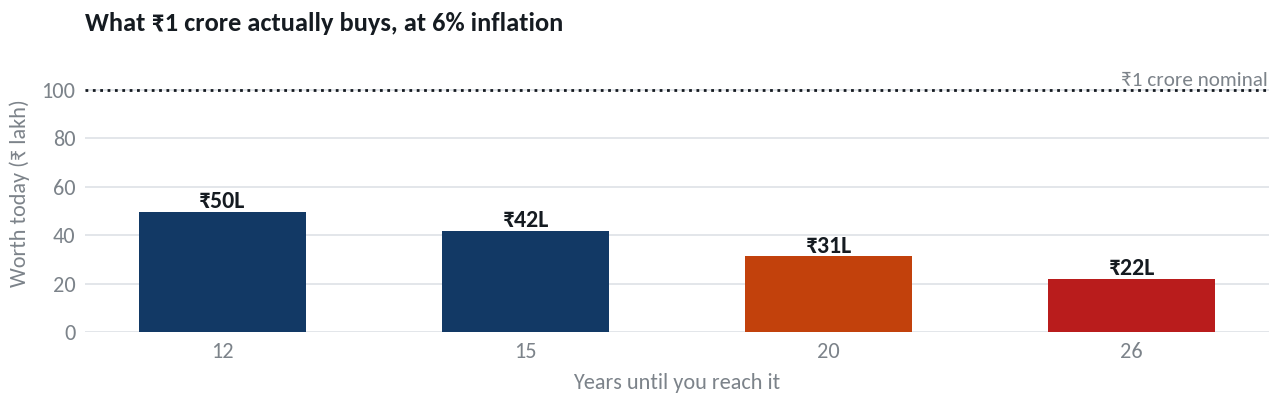
FormulaReal value = Nominal ÷ (1 + inflation)ⁿ
Example₹1 crore in twenty years at 6% inflation buys what about ₹31 lakh buys today.
The amount paid to maintain cover. Best compared per lakh of cover rather than in absolute terms.
Example₹1 crore of term cover for a healthy 30-year-old commonly costs ₹700–1,200 a month.
Insurance is the subject matter of solicitation.
The price of using someone else's money — paid when you borrow, received when you save.
FormulaSimple interest = P × r × t
Example₹10,000 at 7% for one year earns ₹700.
A government arrangement that pays education loan interest during the moratorium for eligible students, typically income-tested.
ExampleEligibility and income thresholds change; verify with the lender and the scheme's official page.
Putting money to work so it may grow, accepting that its value can fall along the way.
ExampleMoney in a fixed deposit is safe and slow; money in equity is volatile and historically faster.
The annual growth rate assumed for invested money in projections. A scenario input, never a promise.
FormulaFuture value = Present × (1 + return)ⁿ
ExampleA 12% assumption is common for long-term diversified equity; real returns vary and can be negative.
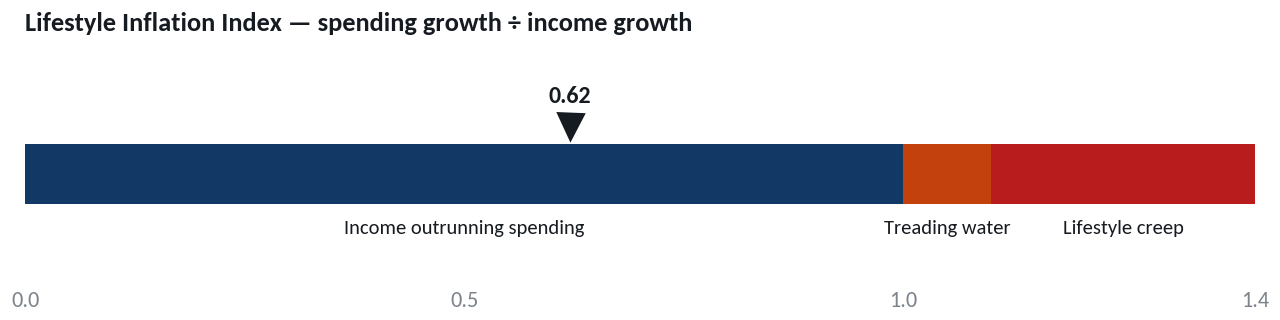
Growth in spending divided by growth in income across two periods. Below 1 means income is outrunning spending; above 1.1 signals lifestyle creep.
FormulaLII = % growth in spending ÷ % growth in income
ExampleSpending up 6%, income up 12% → LII 0.50, healthy. Spending up 14%, income up 12% → 1.17, creep.
How quickly an asset converts to cash without losing value.
ExampleA savings account is fully liquid; a flat may take months and a price concession.
Money reachable within a day or two without loss of value — savings accounts, sweep deposits and liquid funds. Equity, PF and property do not count.
Example₹1,30,000 in a savings account counts; ₹4,00,000 in an SIP does not.
The minimum time money must stay invested before withdrawal is permitted.
ExampleELSS funds lock in for three years; PPF for fifteen.
The share of an income increase that was saved rather than spent. The cleanest test of how a raise was handled.
FormulaMSR = (Increase in savings ÷ Increase in income) × 100
ExampleIncome up ₹6,000, savings up ₹3,000 → 50% of the raise retained.
The twelve-month view of the current budget with inflation applied, showing how a flat plan drifts across a year.
FormulaMonth n = Base × (1 + monthly inflation)ⁿ⁻¹
Example₹62,000 of expenses at 6% annual inflation reaches about ₹65,200 by December.
An agreed period during which repayments are paused or reduced. Interest usually continues to accrue, so the total repaid rises.
ExampleA six-month moratorium on a home loan can add a year or more to the tenure.
The period during study and shortly after when no repayment is required. Interest usually accrues throughout and is added to the balance.
ExampleA two-year moratorium on ₹20 lakh at 10% adds roughly ₹4 lakh before repayment begins.
A pooled vehicle investing many investors' money in securities, managed professionally and priced daily at net asset value.
ExampleAn index fund tracking the Nifty 50 holds the same 50 companies in the same proportions.
Mutual fund investments are subject to market risks. Read all scheme-related documents carefully.
The per-unit value of a fund, calculated at the end of each trading day.
FormulaNAV = (Assets − Liabilities) ÷ Units outstanding
Example₹10,000 invested at an NAV of ₹250 buys 40 units.
Mutual fund investments are subject to market risks. Read all scheme-related documents carefully.
Needs are things you cannot do without. Wants are everything else. The distinction is the foundation of every budget.
ExampleFood is a need; food delivered from a restaurant is largely a want.
What remains after every expense, including investments and loan repayments, is accounted for.
FormulaSurplus = Total income − Total expenses
Example₹85,000 − ₹62,400 = ₹22,600 surplus.
What actually reaches your bank account after tax and deductions. The correct basis for every budget calculation.
ExampleBudget on the ₹78,000 credited, not the ₹1,00,000 quoted in the offer letter.
The person designated to receive an asset on the holder's death. A nominee receives the asset but does not necessarily own it — succession law determines that.
ExampleNominations should be reviewed after marriage, a birth, or a death in the family.
A regulated retirement scheme with market-linked returns, low costs and a lock-in until 60. Offers an additional deduction above the standard 80C limit.
Example₹5,000 a month from age 30 to 60, at an assumed 10%, builds a substantial retirement corpus.
The value of the alternative given up when money is committed to one use.
Example₹5,000 a month on delivery food, invested instead at 12% for ten years, would be about ₹11.6 lakh.
A government-backed savings scheme with a 15-year term, tax-free returns and an annual contribution cap. Among the safest long-horizon instruments available to an individual.
Example₹1.5 lakh a year for 15 years at about 7.1% accumulates to roughly ₹40 lakh, tax-free.
Repaying part or all of a loan ahead of schedule. Early pre-payment reduces total interest disproportionately because early instalments are interest-heavy.
Example₹5 lakh paid into a 20-year home loan in year three can cut several years off the tenure.
A ceiling you set for a category; the tool flags the category once recorded spending crosses it.
ExampleAlert on fuel above ₹3,500 — triggered at ₹3,780 in a month with extra travel.
The original sum borrowed or invested, before interest.
ExampleOn a ₹40 lakh home loan, ₹40 lakh is the principal; total repayment over 20 years is far higher.
How many years forward the projections run — typically five, seven or ten. Longer horizons compound assumption error, so treat distant years as scenarios rather than estimates.
ExampleA ten-year projection is useful for comparing two choices, not for predicting a number.
The non-tuition costs of studying away from home — accommodation, food, transport, materials. Routinely underestimated.
ExampleOverseas study often costs as much again in living expenses as in tuition.
The rate at which the RBI lends to commercial banks. Movements feed through to loan and deposit rates, which is why it matters to households.
ExampleA 25 basis point cut on a ₹40 lakh floating home loan reduces the EMI by roughly ₹650.
The chance that an outcome differs from what you expected — including for the better, though people mostly mean the worse case.
ExampleA savings account has low risk and low return; equity has higher risk and historically higher long-run return.
One of four automatic tests run against your figures: emergency fund adequacy, EMI load, life cover presence, and retirement trajectory.
ExampleNo term insurance recorded with two dependents present triggers the cover check.
A mental shortcut for how long money takes to double at a given return.
FormulaYears to double ≈ 72 ÷ annual return %
ExampleAt 12%, money doubles in about six years; at 7%, about ten.
The annual rate at which you assume income will rise. Typical private-sector India is 8–12%; be conservative, since the projection is only as good as this input.
FormulaYear n income = Current × (1 + growth)ⁿ
Example₹85,000/month at 8% reaches about ₹1,24,900 in five years.
Money set aside now instead of spent, so it is available later.
ExampleSaving ₹500 a month puts ₹6,000 in hand at the end of a year.
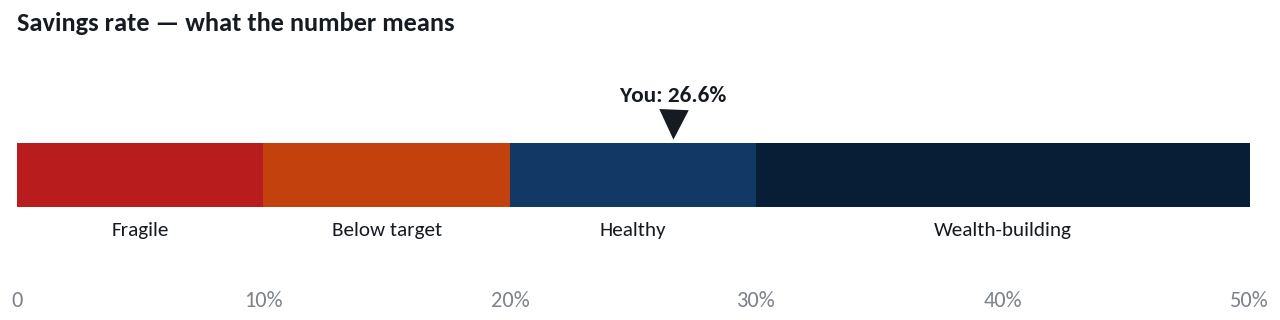
The share of income you keep. The single most useful long-term number in personal finance.
FormulaSavings rate % = ((Income − Expenses) ÷ Income) × 100
Example(₹85,000 − ₹62,400) ÷ ₹85,000 = 26.6% — above the 20% floor.
Example20% is the conventional floor; above 30% builds genuine independence.
The basic condition that money is limited, so choosing one thing means not choosing another.
Example₹1,000 spent on shoes is ₹1,000 not available for books.
Financial support awarded on merit, need or category, which does not require repayment.
ExampleA 50% tuition scholarship halves the corpus required and should be planned for as upside, not assumed.
The income tax provision allowing deduction of interest paid on an education loan, available for a limited number of years from when repayment begins.
ExampleInterest, not principal, qualifies; verify the current terms and the applicable regime.
Investing a fixed amount at regular intervals, which averages the purchase price across market conditions.
Example₹10,000 monthly for 15 years at 12% accumulates to roughly ₹50 lakh.
Mutual fund investments are subject to market risks. Read all scheme-related documents carefully.
A saved record of a completed month — income, expenses, surplus and savings rate — which together form your history and enable trend measures.
ExampleTwo snapshots are the minimum for the Lifestyle Inflation Index to compute.
A gentler word for budget. The plan itself matters more than what it is called.
ExampleWriting the plan down is what makes it work; holding it in your head does not.
A flat reduction from salary income requiring no proof or documentation. Available under both tax regimes, at amounts that change with the Budget.
ExampleVerify the current amount before relying on it in any calculation.
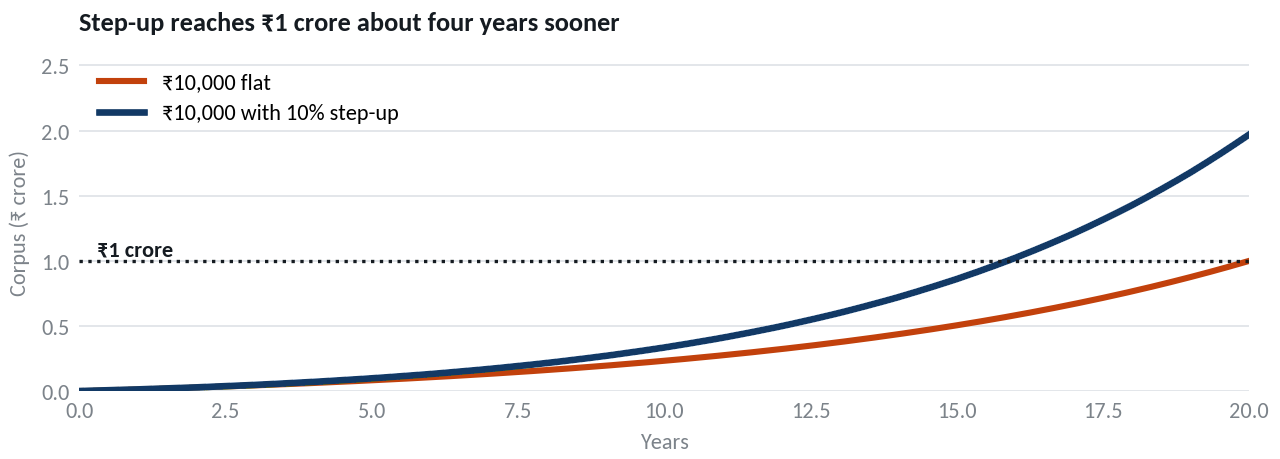
Increasing a recurring investment by a set percentage each year, usually in line with salary growth. The most effective lever available to a salaried earner.
FormulaYear n amount = Starting × (1 + step-up)ⁿ⁻¹
Example₹10,000/month rising 10% a year reaches ₹1 crore roughly four years sooner than a flat ₹10,000.
A government savings scheme for a girl child, offering a fixed rate and tax benefits, with withdrawal permitted for higher education at a specified age.
ExampleContributions until the child is 15, with the account maturing at 21.
The amount an insurer pays on a valid claim. For term cover, commonly set at 10–15 times annual income where dependents exist.
Example₹10 lakh annual income suggests ₹1–1.5 crore of term cover.
Insurance is the subject matter of solicitation.
A savings account linked to a fixed deposit, so balances above a threshold earn FD rates while remaining available on demand. Useful for emergency funds.
Example₹3 lakh held in a sweep account earns near-FD returns without sacrificing access.
An amount subtracted from taxable income before tax is calculated, reducing tax at your marginal rate.
FormulaTax saved = Deduction × marginal tax rate
ExampleA ₹1.5 lakh deduction at a 30% marginal rate saves ₹45,000, plus applicable cess.
India offers two systems: the old regime with deductions and exemptions, and the new regime with lower rates but fewer deductions. Which is better depends on your deduction profile.
ExampleHouseholds with a home loan, HRA and full 80C use often favour the old regime; verify annually.
Tax withheld by the payer before money reaches you, and credited against your final liability.
ExampleA bank deducts TDS on FD interest above the annual threshold before crediting it.
Fees charged two or three times a year rather than monthly — the most common cause of a household budget failing in a particular month.
FormulaMonthly provision = Annual fees ÷ 12
Example₹24,000 per term across two terms = ₹48,000 a year = a ₹4,000 monthly provision.
Pure life cover with no maturity value — the cheapest way to protect dependents against loss of income.
Example₹1 crore cover for a 30-year-old non-smoker commonly costs under ₹15,000 a year.
Insurance is the subject matter of solicitation.
What you give up to get something else. Every financial decision contains one.
ExampleSpending now means less later; saving now means less enjoyment today.
Recurring school costs outside tuition that are rarely budgeted, though together they can rival a term's fees.
ExampleSchool bus at ₹1,800 a month plus ₹6,000 a year of uniforms and books.
Supplementary teaching outside school. A substantial and rising line in Indian household budgets, particularly in examination years.
ExampleCompetitive examination coaching commonly runs to ₹1–2 lakh a year.
A cost that was not in the plan — a medical emergency, a repair, an unexpected trip. Recorded separately so it does not distort the discipline report.
ExampleA ₹14,000 vehicle repair recorded as unplanned rather than absorbed into routine maintenance.
India's real-time payment system. Its convenience is also why spending has become difficult to recall — small payments leave little memory trace.
ExampleTwelve UPI payments of ₹200 in a week total ₹2,400 that few people could reconstruct.
How far actual spending ran from plan, expressed as a share, so categories of different sizes can be compared.
FormulaVariance % = ((Actual − Budget) ÷ Budget) × 100
ExampleBudget ₹9,000, actual ₹10,400 → +15.6% over.
Projected investment value at the end of each year, compounding prior balances and adding the year's surplus. An illustration at constant rates.
FormulaWealthₙ = Wealthₙ₋₁ × (1 + return) + Annual surplus
Example₹12,000/month at 12% reaches roughly ₹27.9 lakh by year ten.
A tax on total assets rather than income. Abolished in India in 2015; still encountered in older material and other jurisdictions.
ExampleNo longer applicable in India.
The percentage of a retirement corpus drawn each year. Around 4% is the conventional planning assumption, though it is contested.
FormulaCorpus needed = Annual expenses ÷ withdrawal rate
Example₹8 lakh a year at 4% implies a ₹2 crore corpus.
The annualised return on a series of irregular cash flows — the correct measure for SIPs, where simple percentage return is misleading.
ExampleMost fund platforms report SIP performance as XIRR for exactly this reason.
Mutual fund investments are subject to market risks. Read all scheme-related documents carefully.
How long a goal takes at the current contribution and assumed return — the answer most goal questions reduce to.
FormulaSolve n in: FV = P × [((1+i)ⁿ − 1) ÷ i] × (1+i)
Example₹10,000/month at 12% reaches ₹1 crore in about 20 years.
Income from an investment as a percentage of its current value.
FormulaYield % = (Annual income ÷ Current value) × 100
ExampleA flat worth ₹80 lakh let at ₹20,000 a month yields 3% before costs and tax.
Assigning every rupee of income a specific purpose before the month begins, so nothing is unaccounted for.
FormulaIncome − All allocations = ₹0
Example₹85,000 of income fully allocated, including ₹22,600 deliberately assigned to savings.
A test that every rupee of income has been assigned a purpose, including money deliberately left in savings.
FormulaIncome − All allocations = ₹0
Example₹85,000 income less ₹85,000 of assignments leaves nothing unaccounted for.
Fee instalment arrangements presented as interest-free, where the cost is generally embedded in the headline fee or a processing charge.
ExampleCompare the total paid under the instalment plan against the lump-sum fee before accepting.
No term matches that.